Heartburn usually strikes at the worst moment: after a big dinner, halfway through the night, or right before a meeting. The best OTC medicine for acid reflux depends on what you need right then: relief in minutes, protection for the next few hours, or help with reflux that follows you to bed. This guide ranks the fast-acting options people actually buy (TUMS, Gaviscon, and Pepcid Complete) by the strength of the evidence behind them, then looks honestly at the supplements people ask about, including DGL licorice, melatonin, and ginger. If you have frequent reflux and are weighing daily PPIs against H2 blockers, our complete acid reflux and GERD treatment guide covers that decision in depth.
This article is for general education and isn't a substitute for advice from your own doctor.
Quick Answer
For occasional heartburn, a chewed calcium carbonate antacid like TUMS starts neutralizing acid within 30 minutes but lasts only about an hour. Pepcid Complete adds famotidine for hours of coverage, and Gaviscon suits after-meal reflux, though most alginate raft trials used UK formulas. DGL and melatonin have only small positive trials and don't replace medication.
How Fast-Acting Reflux Remedies Differ
The OTC options in this guide work in three different ways, and matching the mechanism to your symptoms matters more than picking a brand.
- Antacids (calcium carbonate in TUMS; aluminum and magnesium salts in Gaviscon) chemically neutralize acid that's already there. They're the fastest option but don't reduce how much acid your stomach makes next.
- Alginates are gelling agents that react with stomach acid to form a floating layer, often called a raft. Imaging studies show the raft settles on the acid pocket, the pool of unbuffered acid that sits on top of a meal and is a main source of after-meal reflux PMID: 23669304.
- H2 blockers (famotidine, the drug in Pepcid) reduce acid production. They take longer to start working but last much longer than antacids PMID: 8618369.
Daily proton pump inhibitors (PPIs) such as omeprazole remain the medical treatment of choice for GERD, according to the American College of Gastroenterology's 2022 guideline PMID: 34807007. They aren't built for fast relief, though, which is why the on-demand options below still matter.
What Works Fastest for Heartburn?
A chewed antacid wins on speed. In a randomized, placebo-controlled crossover trial in 18 volunteers, a 1,000 mg calcium carbonate dose (TUMS) neutralized acid within the first 30 minutes after a meal, but its effect lasted only about 60 minutes. Famotidine 10 mg (Pepcid AC) didn't begin working until about 90 minutes, but its effect lasted at least 540 minutes, or 9 hours. At their peaks, the two were similarly potent PMID: 8618369.
How you take an antacid matters too. In a study of 20 people with episodic heartburn, chewable calcium carbonate tablets raised esophageal pH for about 40 to 45 minutes after a reflux-provoking meal, while the same drug in swallowable tablets had little effect. The authors concluded that chewing controls esophageal acid more effectively than swallowing PMID: 11876696. The takeaway is to chew antacid tablets thoroughly rather than swallowing them whole.
Not all antacids behave the same. In a crossover trial of 83 people with heartburn, a high-potency aluminum and magnesium hydroxide antacid kept esophageal pH raised for 82 minutes, compared with 60 minutes for calcium carbonate. After calcium carbonate, stomach pH stayed at or below placebo levels, which the researchers described as consistent with acid rebound PMID: 11854825. That was a different aluminum and magnesium product (Mylanta), not Gaviscon, so treat it as evidence about the antacid class rather than a head-to-head brand result.
Gaviscon vs Tums: Does the Alginate Raft Matter?
Alginate has a genuinely good evidence base. A 2017 meta-analysis of 14 randomized trials with 2,095 participants found that alginate-based therapies roughly quadrupled the odds of GERD symptom resolution compared with placebo or antacids (odds ratio 4.42). Compared with PPIs or H2 blockers, alginates looked less effective, but that difference wasn't statistically significant PMID: 28375448.
The mechanism studies are striking. In 16 GERD patients with large hiatal hernias, an alginate-antacid liquid localized to the acid pocket after a meal. It cut acid reflux episodes to a median of 3.5, compared with 15 for a plain antacid, and delayed the first acid reflux to 63 minutes versus 14 PMID: 23669304. In a double-blind crossover study that matched acid-neutralizing strength, the same alginate-antacid liquid reduced distal esophageal acid exposure from 30 to 150 minutes after a meal better than a store-brand antacid. It didn't reduce the number of reflux events, though, suggesting it works mainly by displacing and neutralizing the acid pocket rather than stopping reflux altogether PMID: 25041141. And in a 4-week trial of 195 people with non-erosive reflux disease, a sodium alginate suspension taken three times daily was non-inferior to omeprazole 20 mg, with adequate relief in 53.3% versus 50.5% PMID: 24024757.
There's an important caveat for US shoppers. The formulas in those studies were UK and European alginate products such as Gaviscon Double Action, or sodium alginate suspensions. US Gaviscon Extra Strength lists aluminum hydroxide and magnesium carbonate as its active ingredients, with sodium alginate or alginic acid among the inactive ingredients. We couldn't find published trials testing the US Extra Strength formula itself, so you can't assume it will match those UK results. What US Gaviscon reliably offers is an aluminum and magnesium antacid that also contains alginate.
So, Gaviscon vs Tums? For a quick, occasional burn, TUMS is cheaper and well studied. For reflux that tends to follow a large meal, Gaviscon's combination of antacid and alginate is the more plausible fit, with the formulation caveat above.
Best OTC Medicine for Acid Reflux: Our Rankings
These ratings weigh the strength of the evidence for each product's ingredients alongside practicality: speed, duration, cost, and safety limits. They're meant for occasional or breakthrough symptoms, not for managing frequent GERD on your own.
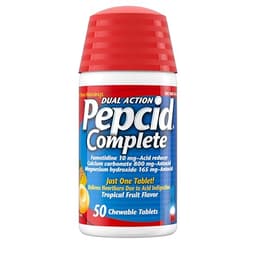
Pepcid Complete (famotidine 10 mg + calcium carbonate + magnesium hydroxide)
Best For
Heartburn that's happening now when you also want hours of protection
Works In
Antacid within minutes; famotidine from about 90 minutes, lasting 9+ hours
Price
$20.00
$0.40 / count
Pros
- ✓Pairs a fast-onset antacid with famotidine, whose effect lasted at least 9 hours in a controlled trial
- ✓Covers the gap before famotidine starts working, about 90 minutes after a 10 mg dose
- ✓Chewable format, which controls esophageal acid better than swallowed antacid tablets
Cons
- ✗We didn't find a published efficacy trial of this combination product itself; the evidence comes from its ingredients
- ✗Combining an antacid with an H2 blocker adds two ways to interfere with other medications' absorption
- ✗Costs more per dose than a plain antacid, and the label limits how long you can use it without a doctor
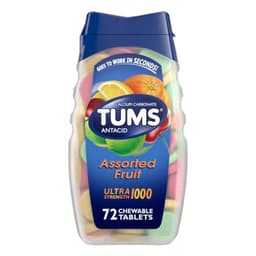
TUMS Ultra Strength 1000 (calcium carbonate)
Best For
Fast, cheap relief for occasional heartburn
Works In
Within 30 minutes; lasts about an hour
Price
$5.99
$0.08 / count
Pros
- ✓Neutralized acid within the first 30 minutes in a randomized crossover trial
- ✓Least expensive option here, and easy to carry
- ✓Well studied: chewing calcium carbonate raised esophageal pH, while swallowing tablets whole did little
Cons
- ✗Short effect, about 60 minutes in a controlled trial, so symptoms can return
- ✗Stomach pH stayed at or below placebo levels afterward in one trial, consistent with acid rebound
- ✗Chronic overuse has caused milk-alkali syndrome (high calcium, alkalosis, kidney injury)
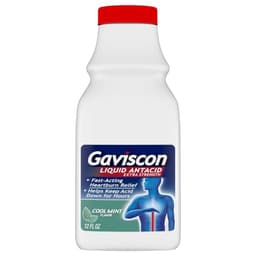
Gaviscon Extra Strength Liquid (Cool Mint)
Best For
Reflux after large meals, when an antacid with alginate is a plausible fit
Works In
Minutes; UK alginate studies measured benefits up to about 2.5 hours after a meal
Price
$10.38
$0.87 / fluid ounce
Pros
- ✓Alginate therapies beat placebo or antacids for symptom resolution in a 14-trial meta-analysis
- ✓Liquid form, like the alginate-antacid liquids used in the acid-pocket studies
- ✓Aluminum and magnesium antacids outlasted calcium carbonate on esophageal pH in one trial
Cons
- ✗US active ingredients are aluminum hydroxide and magnesium carbonate; alginate is listed as inactive, and the raft trials used UK and EU formulas
- ✗Magnesium can build up in people with reduced kidney function, so kidney disease is a reason to ask a doctor first
- ✗Less portable than tablets, and it can interfere with absorption of some antibiotics
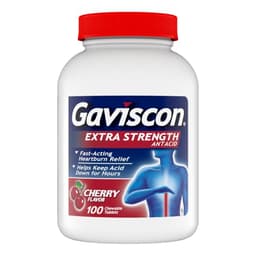
Gaviscon Extra Strength Chewable Tablets (Cherry)
Best For
People who want Gaviscon's formula in a portable form
Works In
Minutes, when chewed thoroughly
Price
$10.18
$0.10 / count
Pros
- ✓Same aluminum and magnesium antacid ingredients as the liquid, in a take-anywhere format
- ✓Chewable, which matters because chewing antacids controlled esophageal acid better than swallowing tablets
- ✓Large 100-count bottle keeps the per-dose cost low
Cons
- ✗The acid-pocket and non-inferiority studies we cite tested liquids or suspensions, not US chewables
- ✗Same US formulation caveat: alginate isn't an active ingredient here
- ✗Same kidney and drug-interaction cautions as other aluminum and magnesium antacids
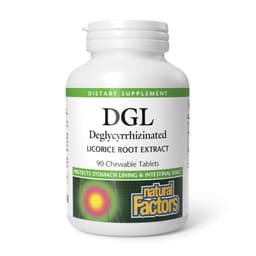
DGL Licorice Chewables (Natural Factors)
Best For
Mild, recurring symptoms as a non-drug add-on, not fast relief
Works In
Days to weeks in trials, not minutes
Price
$13.27
$0.15 / count
Pros
- ✓A 200-person randomized trial of a standardized DGL extract improved heartburn and regurgitation versus placebo
- ✓Deglycyrrhizinated forms limit glycyrrhizin, the licorice compound linked to high blood pressure and fluid retention
- ✓A non-drug add-on you can discuss with your doctor for mild, recurring symptoms
Cons
- ✗The positive trial tested a specific extract (GutGard), not these chewables
- ✗One single-centre trial is thin evidence next to the drug options above
- ✗Not a substitute for acid-reducing medication in frequent GERD or esophagitis
Amazon prices retrieved from the Amazon Product Advertising API on . Prices and availability are accurate as of that time and may change.
Why Pepcid Complete ranks first (4.4). It combines two ingredients with complementary, well-measured effects: calcium carbonate works within 30 minutes but fades within an hour, while famotidine starts at about 90 minutes and lasts 9 hours or more PMID: 8618369. We docked it slightly because we didn't find an efficacy trial of the combination product itself, and because pairing an antacid with an H2 blocker raises the risk of drug interactions through two mechanisms PMID: 21942976.
Why TUMS is second (4.2). It's the fastest and cheapest option, with direct trial data PMID: 8618369 PMID: 11876696. Its short duration and signs of acid rebound PMID: 11854825 keep it out of the top spot.
Why Gaviscon Liquid is third (4.1) and the chewables fourth (3.9). Alginate has the largest trial base of any on-demand option here PMID: 28375448, but those trials used formulas that differ from the US Extra Strength products, so we didn't give Gaviscon full credit for them. The liquid edges out the tablets because the acid-pocket studies used liquids PMID: 23669304 PMID: 25041141.
Why DGL stays at 3.2. Our GERD treatment guide rated DGL 3.2, and we kept it there. The 2025 GutGard trial is a real step forward PMID: 39929150, but it tested one standardized extract in one centre, not the chewables in this list, so it doesn't justify a higher score for this product.
Which One for Which Situation
| Reasonable first choice | Why | |
|---|---|---|
| Occasional burn happening right now | TUMS Ultra (chewed) | Starts neutralizing acid within 30 minutes; cheapest option |
| Reflux that follows a big meal | Gaviscon Extra Strength Liquid | Antacid plus alginate; UK alginate formulas targeted the after-meal acid pocket |
| Burning now, long evening ahead | Pepcid Complete | Antacid for now, famotidine for the next several hours |
| Known trigger meal coming up | Pepcid AC (famotidine) taken beforehand | Famotidine needs about 90 minutes to start working, so timing matters |
| Heartburn 2 or more days a week | A 14-day OTC PPI course, then see a doctor if it recurs | PPIs are the guideline treatment of choice for GERD |
| Pregnant | Ask your obstetric provider; antacids and alginates are usual first-line options | Few reflux drugs are ruled out in pregnancy, but not all have been well studied |
| Kidney disease | Ask your doctor before any antacid | Magnesium can build up when kidney function is reduced |
| Taking doxycycline, ciprofloxacin, or a bisphosphonate | Space doses apart or use a different option | Antacid minerals can bind these drugs and block absorption |
If you can predict your heartburn, such as before a spicy dinner, a late meal or another of your personal reflux trigger foods, famotidine taken ahead of time makes more sense than chasing symptoms with antacids, because its effect starts later but lasts for hours PMID: 8618369. Pepcid AC Maximum Strength contains 20 mg of famotidine, double the dose in Pepcid Complete.
If your upper-abdominal symptoms are mostly pressure, fullness, and gas rather than burning, an antacid probably isn't the right tool. Our guide to fixing bloating walks through matching the symptom to its likely cause.
Supplements for Acid Reflux: What the Evidence Shows
Most searches for the best supplements for acid reflux turn up long lists. Very few of those supplements have been tested in randomized trials in people with reflux. Here's where the better-studied ones stand.
Does DGL Licorice Work for Reflux?
DGL is licorice root with most of its glycyrrhizin removed, the compound responsible for licorice's effects on electrolytes, blood pressure, and fluid retention. In a 2025 double-blind trial, 200 adults with reflux symptoms took GutGard, a flavonoid-rich DGL extract, or placebo for 28 days. The GutGard group reported better quality of life and earlier resolution of heartburn (significant by day 14) and regurgitation (by day 7) PMID: 39929150. That's encouraging, but it's one single-centre trial of one extract. It doesn't tell you whether a typical chewable DGL tablet works, or at what dose.
Is Melatonin Good for GERD?
Melatonin has one of the more interesting evidence trails for a supplement, but it's thin. In a 2023 randomized, double-blind trial, 78 people with GERD took omeprazole 20 mg plus either 3 mg of sublingual melatonin or placebo for 4 weeks. Heartburn, epigastric pain, and reflux symptom scores fell more with melatonin, quality of life improved, and side effects were similar between groups PMID: 37768310. That trial tested melatonin as an add-on to a PPI, in 72 people who finished the study. It doesn't show that melatonin works on its own, and it isn't a reason to stop prescribed treatment.
Ginger, Apple Cider Vinegar, and Other Home Remedies
Ginger is often recommended for reflux, but the direct evidence is missing. In a small randomized crossover study of 11 people with functional dyspepsia, 1.2 g of ginger sped up stomach emptying (a half-emptying time of 12.3 versus 16.1 minutes) without improving symptoms PMID: 21218090. We didn't find randomized trials of ginger or apple cider vinegar as a reflux treatment in our PubMed search, so we don't recommend either as a reflux remedy. If bloating and indigestion bother you more than burning, our ranking of supplements for bloating covers options with better data for those symptoms.
How to Use Antacids Safely
Antacids are sold over the counter, but they aren't risk-free, especially if you take them often.
- Chew, don't swallow. Chewed calcium carbonate raised esophageal pH, while swallowed tablets had little effect PMID: 11876696.
- Respect the daily maximum. Each Drug Facts label lists a maximum number of doses per 24 hours and says not to use the maximum dose for more than 2 weeks unless a doctor advises it. Overdoing calcium carbonate is a real risk: a 2026 case report described a man whose chronic overuse of calcium carbonate tablets for reflux led to milk-alkali syndrome, with high calcium, metabolic alkalosis, and acute kidney injury PMID: 42180434.
- Be careful with kidney disease. Magnesium is cleared by the kidneys. A case series described four older adults with kidney dysfunction who developed symptomatic hypermagnesemia from magnesium oxide, one of whom died PMID: 30136128. That involved a magnesium laxative, not an antacid, but it's why Gaviscon's label tells people with kidney disease to ask a doctor first.
- Space antacids from other medications. The minerals in antacids can bind tetracycline and fluoroquinolone antibiotics and sharply reduce their absorption. A drug-interaction review advises taking the antacid either 4 hours before or 2 hours after these antibiotics. Bisphosphonates and some targeted cancer drugs may also be affected PMID: 21942976. Ask a pharmacist before combining an antacid with any regular prescription.
- In pregnancy, check with your provider. Reflux affects up to 80% of pregnant women. A review of heartburn management in pregnancy lists antacids, alginates, and sucralfate as first-line options, with H2 blockers next if symptoms persist PMID: 31950535. Not every reflux drug has been well studied in pregnancy, so confirm your choice and dose with your obstetric provider.
When to Step Up to a PPI
If you're reaching for antacids more than twice a week, on-demand relief has probably stopped being the right strategy. PPIs remain the guideline-recommended medical treatment for GERD PMID: 34807007. OTC omeprazole and esomeprazole are labeled as a 14-day course, no more often than every 4 months unless a doctor advises otherwise. OTC famotidine labels similarly say not to use it for more than 14 days in a row without talking to a doctor. Our GERD treatment guide explains how PPIs and H2 blockers compare and how to step down safely.
Long-term PPI use has trade-offs worth discussing with your doctor. A meta-analysis of 11 studies with 3,134 people found PPI users had about twice the odds of small intestinal bacterial overgrowth (SIBO), though that link appeared only when SIBO was diagnosed by intestinal aspirate culture, not breath testing PMID: 23270866. Our SIBO guide covers the symptoms and testing.
When to See a Doctor
Don't self-treat these warning signs. Get prompt medical care if heartburn comes with:
- Trouble swallowing, or pain when swallowing
- Unintended weight loss
- Repeated vomiting, vomiting blood, or black or bloody stools
- Anemia, or unexplained fatigue and paleness
- Chest pain, especially with shortness of breath, sweating, or pain spreading to the arm or jaw. Treat it as a possible heart problem and call emergency services rather than taking an antacid.
Also see a doctor if heartburn happens twice a week or more, keeps coming back after a 14-day OTC course, or if you need antacids most days. Not sure where your symptoms fit? Our gut health quiz can help you figure out which guide to start with.
Frequently Asked Questions
Gaviscon vs Tums: which is better for acid reflux? They suit different situations. TUMS (calcium carbonate) is cheap and starts neutralizing acid within about 30 minutes, but its effect lasts roughly an hour. Gaviscon is an aluminum and magnesium antacid that also contains alginate, which in trials of UK formulas formed a raft over the after-meal acid pocket and reduced acid reaching the esophagus. US Gaviscon Extra Strength lists alginate as an inactive ingredient, so those trial results can't be assumed to transfer exactly.
What works fastest for heartburn? A chewed antacid. In a controlled study, 1,000 mg of calcium carbonate neutralized acid within the first 30 minutes, while famotidine 10 mg didn't start working until about 90 minutes. Famotidine lasted at least 9 hours, compared with about an hour for the antacid, which is why combination products like Pepcid Complete pair the two.
Does DGL licorice work for acid reflux? The evidence is limited. A 2025 randomized trial of 200 people found that a specific flavonoid-rich deglycyrrhizinated licorice extract (GutGard) improved heartburn, regurgitation and quality of life over 28 days compared with placebo. That was one single-centre trial of one standardized extract, not the chewable DGL tablets most people buy, and DGL isn't a fast-acting remedy.
Is melatonin good for GERD? It's promising but unproven. In a 2023 randomized trial of 78 people, adding 3 mg of sublingual melatonin to omeprazole for 4 weeks reduced heartburn and epigastric pain more than omeprazole plus placebo. That's one small add-on trial, so melatonin isn't a substitute for acid-reducing medication.
Are antacids safe to take every day? Occasional use is generally fine, but antacids aren't meant for long-term daily use without a doctor. Overusing calcium carbonate has caused milk-alkali syndrome with high calcium and kidney injury, magnesium can build up in people with reduced kidney function, and antacids can block absorption of some antibiotics and other drugs. Needing an antacid most days is a reason to get evaluated.
When should heartburn be checked by a doctor? Get medical care promptly for trouble or pain swallowing, unintended weight loss, vomiting, black or bloody stools, anemia, or chest pain, which should be treated as a possible heart problem first. Also see a doctor if heartburn happens twice a week or more, or keeps returning after a 14-day course of OTC medication.
References
- Rohof WO, Bennink RJ, Smout AJ, et al. An alginate-antacid formulation localizes to the acid pocket to reduce acid reflux in patients with gastroesophageal reflux disease. Clinical Gastroenterology and Hepatology. 2013;11(12):1585-1591. PMID: 23669304.
- Feldman M. Comparison of the effects of over-the-counter famotidine and calcium carbonate antacid on postprandial gastric acid: a randomized controlled trial. JAMA. 1996;275(18):1428-1431. PMID: 8618369.
- Katz PO, Dunbar KB, Schnoll-Sussman FH, et al. ACG Clinical Guideline for the Diagnosis and Management of Gastroesophageal Reflux Disease. American Journal of Gastroenterology. 2022;117(1):27-56. PMID: 34807007.
- Robinson M, Rodriguez-Stanley S, Miner PB, et al. Effects of antacid formulation on postprandial oesophageal acidity in patients with a history of episodic heartburn. Alimentary Pharmacology & Therapeutics. 2002;16(3):435-443. PMID: 11876696.
- Decktor DL, Robinson M, Maton PN, et al. Effects of aluminum/magnesium hydroxide and calcium carbonate on esophageal and gastric pH in subjects with heartburn. American Journal of Therapeutics. 1995;2(8):546-552. PMID: 11854825.
- Leiman DA, Riff BP, Morgan S, et al. Alginate therapy is effective treatment for GERD symptoms: a systematic review and meta-analysis. Diseases of the Esophagus. 2017;30(5):1-9. PMID: 28375448.
- De Ruigh A, Roman S, Chen J, et al. Gaviscon Double Action Liquid (antacid & alginate) is more effective than antacid in controlling post-prandial oesophageal acid exposure in GERD patients: a double-blind crossover study. Alimentary Pharmacology & Therapeutics. 2014;40(5):531-537. PMID: 25041141.
- Chiu CT, Hsu CM, Wang CC, et al. Randomised clinical trial: sodium alginate oral suspension is non-inferior to omeprazole in the treatment of patients with non-erosive gastroesophageal disease. Alimentary Pharmacology & Therapeutics. 2013;38(9):1054-1064. PMID: 24024757.
- Ogawa R, Echizen H. Clinically significant drug interactions with antacids: an update. Drugs. 2011;71(14):1839-1864. PMID: 21942976.
- Raj JP, Saxena U, Belhekar MN, et al. Efficacy and safety of GutGard in managing gastroesophageal reflux-related symptoms: a phase III, single-centre, double-blind, randomized placebo-controlled trial. Complementary Medicine Research. 2025;32(1):26-36. PMID: 39929150.
- Malekpour H, Noori A, Abdi S, et al. Is the addition of sublingual melatonin to omeprazole superior to omeprazole alone in the management of gastroesophageal reflux disease symptoms: a clinical trial. Turkish Journal of Gastroenterology. 2023;34(12):1206-1211. PMID: 37768310.
- Hu ML, Rayner CK, Wu KL, et al. Effect of ginger on gastric motility and symptoms of functional dyspepsia. World Journal of Gastroenterology. 2011;17(1):105-110. PMID: 21218090.
- Varghese S, Cinnamond K, Malek B, et al. Antacid abuse: a case of milk-alkali syndrome. Irish Medical Journal. 2026;119(5):88. PMID: 42180434.
- Yamaguchi H, Shimada H, Yoshita K, et al. Severe hypermagnesemia induced by magnesium oxide ingestion: a case series. CEN Case Reports. 2019;8(1):31-37. PMID: 30136128.
- Thélin CS, Richter JE. Review article: the management of heartburn during pregnancy and lactation. Alimentary Pharmacology & Therapeutics. 2020;51(4):421-434. PMID: 31950535.
- Lo WK, Chan WW. Proton pump inhibitor use and the risk of small intestinal bacterial overgrowth: a meta-analysis. Clinical Gastroenterology and Hepatology. 2013;11(5):483-490. PMID: 23270866.