Seed DS-01 and Ritual Synbiotic+ are the two best-known direct-to-consumer synbiotics, both pitched as a more sophisticated upgrade over a drugstore probiotic bottle. They're also both priced like it — roughly $45 to $55 a month, subscription-first, with slick branding and pages of ingredient science. This comparison breaks down what's actually inside each capsule, what's genuinely been studied, and where the marketing runs ahead of the evidence.
This article is for general education and isn't a substitute for care from your own physician or gastroenterologist.
Quick Answer
Both are well-formulated premium synbiotics: Seed now has three company-funded, placebo-controlled trials on its finished DS-01 product, including a 350-person trial on bloating and GI quality of life, while Ritual still has no published trial of its finished Synbiotic+ capsule at all — though neither company's evidence comes from independent researchers or from patients with a diagnosed condition like IBS. Ritual leans on two well-studied named strains plus a novel phage-based prebiotic; Seed leans on breadth (24 strains), a two-capsule delivery system, and its newer finished-product trial data; pick based on which evidence and mechanism you trust more.
Sources: PMID 41599868, PMID 40944126, PMID 34918142
How 2-in-1 and 3-in-1 Synbiotics Are Supposed to Work
A synbiotic, by the 2020 expert consensus definition from the International Scientific Association for Probiotics and Prebiotics (ISAPP), is a mixture of live microorganisms and a substrate that's selectively used by host microorganisms, together conferring a health benefit PMID: 32826966. In plain terms: a probiotic (live bacteria) paired with something meant to help it, or the resident gut microbes, work better.
Seed DS-01 is a "2-in-1" synbiotic — a probiotic blend plus a single prebiotic ingredient. Ritual Synbiotic+ goes a step further and calls itself a "3-in-1," adding a postbiotic component on top of its probiotic and prebiotic. Postbiotics are typically inactivated microbial preparations or microbial metabolites — in Ritual's case, tributyrin, a compound that breaks down into butyrate, a short-chain fatty acid that helps fuel colon cells and support the gut's barrier function PMID: 36763294. That's a legitimate biological mechanism. It is not the same thing as evidence that swallowing 300 mg of it daily changes how someone's gut actually feels.
Both companies also emphasize delivery technology — engineering meant to protect live bacteria through stomach acid and bile so they arrive intact further down the GI tract, where they're theoretically more likely to do something.
Our Rankings
Both products are evaluated here side by side rather than against a single "winner," because the honest answer is that they're built on different bets, not on comparable proof.
| Seed DS-01 | Ritual Synbiotic+ | |
|---|---|---|
| Probiotic strains | 24 strains across 4 blends | 2 named strains: LGG + BB-12 |
| Labeled dose | ~53 billion AFU | 11 billion CFU |
| Prebiotic / postbiotic | MAPP polyphenol prebiotic | PreforPro (bacteriophage) prebiotic + tributyrin postbiotic |
| Capsule technology | ViaCap 2-in-1 nested capsule | Single delayed-release capsule |
| Finished-product trials | 3 (company-funded, placebo-controlled; not in diagnosed IBS) | None on the finished capsule |
| Independent replication | Not yet | Not for the finished product |
| Price | $49.99/mo subscription at seed.com; one-time purchase on Amazon | ~$54/mo (~$43.50 with discount); one-time available |
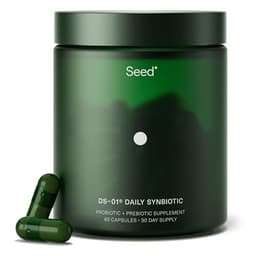
Seed DS-01 Daily Synbiotic
Best For
People who want strain breadth, full transparency, and a two-capsule delivery system
Works In
4+ weeks, per company guidance
Price
$59.99
$1.00 / count
Pros
- ✓24 probiotic strains across four targeted blends, with a published strain list and third-party viability (AFU) testing rather than a vague 'proprietary blend'
- ✓ViaCap two-in-one capsule design: an outer capsule releases the MAPP polyphenol prebiotic in the upper GI tract, while an inner, acid-resistant capsule is engineered to carry live strains to the colon
- ✓Long-standing DTC synbiotic with a large user base and a well-documented ingredient list for anyone comparing labels
- ✓As of 2025-2026, three published, placebo-controlled trials on the finished DS-01 product itself, including a 350-person trial showing improved bloating, gas, and GI quality of life — more finished-product evidence than most DTC probiotics have
Cons
- ✗Its three published finished-product trials are company-funded, not yet independently replicated, and didn't enroll diagnosed IBS patients, so the bloating and GI-comfort results don't directly apply to a diagnosed condition
- ✗The MAPP polyphenol prebiotic (Indian pomegranate extract) has no independent, peer-reviewed clinical trial publicly available
- ✗24 strains in one capsule make it essentially impossible to know which ingredient, if any, is responsible for a change in symptoms — or for side effects
- ✗Subscription-first at seed.com; buying once without a subscription means going through Seed's Amazon store, typically at a higher price
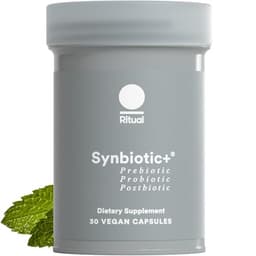
Ritual Synbiotic+
Best For
People who want named, individually-studied strains and a simpler, mechanism-first formula
Works In
2-4 weeks, per company guidance
Price
$59.99
$2.00 / count
Pros
- ✓Two named strains — Lactobacillus rhamnosus GG and Bifidobacterium animalis subsp. lactis BB-12 — are among the most independently studied probiotic strains in the world outside of any Ritual-sponsored research
- ✓LGG has its own randomized, placebo-controlled trial data for reducing abdominal pain frequency and severity in a pediatric IBS population, and a 30-year safety and efficacy review
- ✓BB-12 has meta-analytic support for improving defecation frequency and short-term bowel regularity in adults
- ✓PreforPro, its bacteriophage-based prebiotic, has its own small human trials showing shifts in gut bacterial populations and markers of GI inflammation
- ✓Delayed-release capsule, plus a one-time purchase option directly from Ritual as well as through its Amazon store
Cons
- ✗No published randomized controlled trial of the finished Synbiotic+ capsule itself in IBS or any specific GI condition
- ✗PreforPro's supporting trials paired the phage cocktail with a different Bifidobacterium lactis strain (BL04) than the one actually in this product (BB-12), so that specific phage-plus-BB-12 pairing hasn't itself been tested
- ✗Tributyrin's postbiotic rationale is mechanistically sound but hasn't been validated in a trial of this specific finished formula or dose
- ✗Only 11 billion total CFU across two strains, lower than many competing multi-strain products (though CFU count alone hasn't been shown to predict benefit)
Amazon prices retrieved from the Amazon Product Advertising API on . Prices and availability are accurate as of that time and may change.
Strain Transparency, CFU, and What Each Label Actually Tells You
Seed's approach is breadth: 24 strains organized into a digestive-health blend, a micronutrient-synthesis blend, a dermatological blend, and a cardiovascular blend, totaling roughly 53 billion active fluorescent units (AFU) — Seed's preferred viability metric, measured by flow cytometry rather than the traditional CFU plate-count method most other brands use. That's worth knowing if you're trying to compare Seed's numbers directly against a CFU figure on another label; the two methods aren't interchangeable measures of the same thing.
Ritual's approach is narrowness: two named, dosed strains at 11 billion CFU combined, both with a public research history that exists independently of Ritual's own marketing. That's a meaningful transparency advantage in one specific sense — you can go look up "Lactobacillus rhamnosus GG" or "Bifidobacterium animalis subsp. lactis BB-12" on PubMed and find a genuine, years-deep literature. You cannot do the same for Seed's proprietary MAPP polyphenol prebiotic blend, which currently has no independent published trial that we could locate.
Neither company's strain-level pedigree should be mistaken for finished-product proof. A strain being well-studied in general does not mean the exact combination, dose, and delivery format sold today has been tested — see below.
Capsule Technology: ViaCap vs. Delayed-Release
Seed's ViaCap is a two-capsule design: an outer capsule dissolves in the stomach to release the prebiotic, while a nested inner capsule is built to resist stomach acid, bile, and digestive enzymes so the live probiotic strains survive to reach the colon. Ritual uses a single delayed-release capsule engineered to bypass the stomach and open further down the GI tract, aiming for the same basic goal — getting live organisms past the harshest part of digestion.
Both are reasonable engineering approaches to a real problem: many probiotic organisms lose viability in stomach acid. Neither company has published head-to-head survival data comparing its own capsule technology against a standard capsule in humans, so it's difficult to say with confidence how much either design actually improves on a simple acid-resistant capsule already used by many single-strain competitors.
The Evidence Question: What's Actually Been Tested
This is the section that matters most, and it's worth being blunt about it: as of this writing, Ritual Synbiotic+ has no published, peer-reviewed randomized controlled trial testing its finished, multi-ingredient capsule in any GI condition, and Seed DS-01's three finished-product trials, while real and placebo-controlled, were company-funded, haven't been independently replicated, and didn't enroll patients with a diagnosed condition like IBS. What exists for Ritual is strain-level evidence and mechanistic rationale; what exists for Seed is that same kind of strain-level evidence plus its own newer, but still industry-run, finished-product trial data.
Ritual's case is the stronger of the two on strain-level grounds. LGG has a genuine track record: a randomized, placebo-controlled trial in children and adolescents with functional abdominal pain found it reduced both frequency and severity of pain, an effect that tracked with a marker of gut-barrier function PMID: 21078735, and a 2019 review summarizing three decades of LGG research reinforces both its safety profile and its documented, if strain-specific, effects PMID: 30741841. A 2026 strain-specific meta-analysis of probiotics in IBS specifically named LGG among strains showing benefit for at least one symptom domain, while cautioning that certainty varied by strain and outcome PMID: 41682832. BB-12 has its own separate literature: a systematic review with meta-analysis found that B. animalis subsp. lactis supplementation may increase defecation frequency and improve stool consistency in generally healthy adults PMID: 34918142 — useful if occasional irregularity, not IBS specifically, is your concern.
Ritual's prebiotic, PreforPro, is a genuinely different mechanism worth understanding on its own terms: rather than feeding bacteria with fiber, it's a bacteriophage cocktail designed to selectively reduce certain E. coli populations. A placebo-controlled crossover trial in generally healthy adults found it reduced fecal E. coli loads and increased butyrate-producing bacterial genera, alongside a modest reduction in one inflammatory marker PMID: 30897686. A follow-up trial paired the same phage cocktail with a Bifidobacterium lactis strain (BL04) and found within-group improvements in a GI inflammation marker and a trend toward less reported colon discomfort PMID: 32824480. Two caveats matter here: that companion trial used strain BL04, not the BB-12 strain actually included in Synbiotic+, and both trials were run in healthy or self-reported-symptomatic adults rather than a diagnosed GI condition. The mechanism is interesting; it is not the same as evidence for Ritual's exact formula.
Seed's case has actually strengthened since this comparison was first written. Between 2025 and 2026, Seed Health sponsored three placebo-controlled trials on the finished DS-01 product itself, published in peer-reviewed journals: a 6-week trial in 350 generally healthy adults with self-reported bloating and indigestion found DS-01 significantly improved GI-specific quality of life, bloating and gas scores, and bowel regularity versus placebo PMID: 41599868; a 91-day trial in 32 healthy adults found increases in fecal butyrate, gut bacterial diversity, and the polyphenol-derived metabolite urolithin A PMID: 40944126; and a third trial found DS-01 sped recovery of microbial diversity and gut barrier integrity after a course of antibiotics PMID: 41750436. That's genuinely more finished-product evidence than most DTC probiotics have, including Ritual. But three caveats keep it from settling the question: none of these trials enrolled patients with a diagnosed condition like IBS, so they speak to general gut comfort and biomarkers, not to a diagnosed disorder; all three were funded by Seed Health with company employees, shareholders, or advisors among the authors, and no outside academic lab has yet independently replicated the results; and the MAPP polyphenol prebiotic blend still has no independent, peer-reviewed trial of its own outside these company-sponsored studies.
Zooming out, the low-certainty picture in the underlying research isn't unique to these two brands. A 2018 meta-analysis of prebiotic, probiotic, and synbiotic trials in IBS found that certain combinations appeared beneficial, but the authors were unable to say with confidence which specific ones, describing the underlying evidence base as inconsistent across products and strains PMID: 30294792. A larger 2023 meta-analysis of probiotics in IBS similarly rated the certainty of evidence as low to very low across almost all strain categories, even where a statistical benefit was detected PMID: 37541528. Most premium DTC synbiotics still only extend that same strain-level evidence into new packaging and delivery systems; Seed's newer finished-product trials are the exception, and even they remain company-run and unreplicated rather than the kind of independent, condition-specific evidence this category as a whole is still missing.
Price and Subscription Terms
Seed DS-01 runs $49.99 a month on subscription at seed.com, where there's no one-time purchase option (you can typically cancel before the next shipment). Seed's own Amazon storefront does sell DS-01 as a one-time purchase, usually at a somewhat higher price than the subscription. Ritual Synbiotic+ lists around $54 a month standard, drops to roughly $43.50 a month with an auto-applied subscriber discount, and offers a one-time purchase both on its own site and through its Amazon store. So both can now be tried without committing to recurring billing — the practical difference is where you buy and what you pay.
Who Each Product Suits
Seed DS-01 fits someone who wants the broadest possible strain coverage, values transparent (if unusual) third-party viability testing, and is comfortable relying on company-funded, not-yet-independently-replicated finished-product trial data rather than a trial run in a diagnosed condition — essentially, someone buying into the two-capsule delivery concept, strain diversity, and Seed's newer in-house trial results, not independently confirmed proof for a specific diagnosis. For the full breakdown, see our Seed DS-01 review.
Ritual Synbiotic+ fits someone who wants to be able to look up the exact strains they're taking and find genuine independent research on them, who's intrigued by the phage-based prebiotic mechanism, and who wants the option to try a single bottle before subscribing. It's a better fit if simplicity and traceability matter more to you than strain count. See our full Ritual Synbiotic+ review for the complete write-up.
Neither is a strong fit for someone who wants trial-backed relief for a specific diagnosed condition like IBS, active bloating, or chronic constipation right now. For that, single- or few-strain products with a dedicated clinical trial in that exact condition — not a synbiotic blend built around general wellness — are the more evidence-aligned starting point.
Honest Verdict
Both Seed DS-01 and Ritual Synbiotic+ are competently formulated, transparently labeled (strain-wise, if not always dose-and-trial-wise), and reasonably safe for most healthy adults. Neither is a bad product, and the two are no longer in quite the same evidentiary position: Seed can now point to a company-funded, placebo-controlled trial showing its finished capsule reduced bloating and improved GI quality of life in generally healthy adults, while Ritual still has no trial of its finished capsule at all. That's a real, if limited, point in Seed's favor — limited because the trial wasn't run in diagnosed IBS patients and hasn't been independently replicated, so it doesn't let us say "this capsule was shown to treat IBS." What you're paying the premium DTC price for is still largely strain curation, delivery engineering, and brand polish layered on top of a mixed, strain-specific evidence base — plus, for Seed specifically, some genuine but company-run finished-product data that neither product had a couple of years ago.
If your priority is the strongest available clinical evidence for the fewest dollars, cheaper single-strain over-the-counter options with dedicated trials in a specific condition are worth comparing first. For example, Bifidobacterium infantis 35624 (sold as Align) beat placebo for abdominal pain, bloating, and overall IBS symptom relief in a 4-week trial of 362 women with IBS, but only at one of the three doses tested PMID: 16863564 — see our full rankings of the best evidence-based probiotics for specifics. If your priority is trying a well-engineered, broad-spectrum synbiotic and you've already ruled out a diagnosable condition with your doctor, either Seed or Ritual is a reasonable, if pricey, choice — just don't expect either one to have proven itself the way a dedicated clinical trial would.
Frequently Asked Questions
Is Seed DS-01 or Ritual Synbiotic+ better for IBS? Neither has a published randomized trial specifically in IBS patients. Ritual's LGG strain has separate pediatric IBS pain-reduction data, and its BB-12 strain has meta-analytic support for bowel regularity, but that evidence is strain-level, not proof for the Synbiotic+ capsule as a whole. Seed's 24-strain blend has no comparable published IBS data.
What's the difference between a probiotic, prebiotic, postbiotic, and synbiotic? A probiotic is a live microorganism dosed to confer a benefit. A prebiotic is a substrate selectively used by host microorganisms. A postbiotic is a non-living microbial preparation or metabolite that can still confer a benefit. A synbiotic combines a probiotic with a substrate meant to support it, per the 2020 ISAPP consensus definition.
Do Seed DS-01 or Ritual Synbiotic+ have clinical trials proving they work? As of 2025-2026, yes for Seed — three company-funded, placebo-controlled trials on the finished DS-01 product have been published, including one showing improved bloating and GI quality of life in 350 adults, though none enrolled diagnosed IBS patients and none has been independently replicated yet. Ritual still has no published trial of its finished, multi-ingredient capsule; it relies on published, largely independent trials of its two named strains and its prebiotic ingredient.
Which has more probiotic strains, Seed or Ritual? Seed DS-01 has 24 strains across four blends. Ritual Synbiotic+ has two named strains — LGG and BB-12 — totaling 11 billion CFU.
Is a higher CFU or strain count better? Not necessarily. No published trial shows that more strains or higher CFU counts outperform the lower, single-strain doses used in most successful probiotic trials, and more strains make it harder to identify what's actually driving any change you notice.
Are there cheaper probiotics with better evidence than Seed or Ritual? Yes. Single-strain options like Align (Bifidobacterium infantis 35624) have dedicated randomized trials in IBS patients at a lower monthly cost than either DTC synbiotic. See our rankings of evidence-based probiotics for details.
References
- Swanson KS, Gibson GR, Hutkins R, et al. The International Scientific Association for Probiotics and Prebiotics (ISAPP) consensus statement on the definition and scope of synbiotics. Nature Reviews Gastroenterology & Hepatology. 2020;17(11):687-701. PMID: 32826966.
- Elfadil OM, Mundi MS, Abdelmagid MG, Patel A, Patel N, Martindale R. Butyrate: more than a short chain fatty acid. Current Nutrition Reports. 2023;12(2):255-262. PMID: 36763294.
- Francavilla R, Miniello V, Magistà AM, et al. A randomized controlled trial of Lactobacillus GG in children with functional abdominal pain. Pediatrics. 2010;126(6):e1445-e1452. PMID: 21078735.
- Capurso L. Thirty years of Lactobacillus rhamnosus GG: a review. Journal of Clinical Gastroenterology. 2019;53 Suppl 1:S1-S41. PMID: 30741841.
- Maslennikov R, Gosteeva E, Ananeva V, et al. Strain-specific systematic review with meta-analysis of probiotics efficacy in the treatment of irritable bowel syndrome. Journal of Clinical Medicine. 2026;15(3):1152. PMID: 41682832.
- Araújo MM, Vogado CO, Mendes MM, et al. Effects of Bifidobacterium animalis subspecies lactis supplementation on gastrointestinal symptoms: systematic review with meta-analysis. Nutrition Reviews. 2022;80(6):1619-1633. PMID: 34918142.
- Febvre HP, Rao S, Gindin M, et al. PHAGE study: effects of supplemental bacteriophage intake on inflammation and gut microbiota in healthy adults. Nutrients. 2019;11(3):666. PMID: 30897686.
- Grubb DS, Wrigley SD, Freedman KE, et al. PHAGE-2 study: supplemental bacteriophages extend Bifidobacterium animalis subsp. lactis BL04 benefits on gut health and microbiota in healthy adults. Nutrients. 2020;12(8):2474. PMID: 32824480.
- Allegretti JR, Kassam Z, Kelly CR, et al. A randomized, placebo-controlled trial evaluating multi-species synbiotic supplementation for bloating, gas, and abdominal discomfort. Nutrients. 2026;18(2):255. PMID: 41599868.
- Napier BA, Allegretti JR, Feuerstadt P, et al. Multi-species synbiotic supplementation enhances gut microbial diversity, increases urolithin A and butyrate production, and reduces inflammation in healthy adults: a randomized, placebo-controlled trial. Nutrients. 2025;17(17):2734. PMID: 40944126.
- Napier BA, Allegretti JR, Feuerstadt P, et al. Multi-species synbiotic supplementation after antibiotics promotes recovery of microbial diversity and function, and increases gut barrier integrity: a randomized, placebo-controlled trial. Antibiotics (Basel). 2026;15(2):138. PMID: 41750436.
- Ford AC, Harris LA, Lacy BE, Quigley EMM, Moayyedi P. Systematic review with meta-analysis: the efficacy of prebiotics, probiotics, synbiotics and antibiotics in irritable bowel syndrome. Alimentary Pharmacology & Therapeutics. 2018;48(10):1044-1060. PMID: 30294792.
- Goodoory VC, Khasawneh M, Black CJ, Quigley EMM, Moayyedi P, Ford AC. Efficacy of probiotics in irritable bowel syndrome: systematic review and meta-analysis. Gastroenterology. 2023;165(5):1206-1218. PMID: 37541528.
- Whorwell PJ, Altringer L, Morel J, et al. Efficacy of an encapsulated probiotic Bifidobacterium infantis 35624 in women with irritable bowel syndrome. American Journal of Gastroenterology. 2006;101(7):1581-1590. PMID: 16863564.