Probiotic supplements are a multibillion-dollar category built on a genuinely useful idea — that live microorganisms can influence digestion and the wider gut microbiome — stretched to cover far more than the evidence actually supports. Some strains have real, replicated clinical trial data behind specific uses; most products on a shelf do not. This guide ranks the probiotics with the strongest and broadest evidence, explains the one buying principle that matters more than any other, and is honest about where the science stops and the marketing starts.
This article is for general education and isn't a substitute for advice from your own physician or gastroenterologist.
Quick Answer
Culturelle (Lactobacillus rhamnosus GG) is among the most-replicated over-the-counter probiotic strains, with its clearest evidence for preventing antibiotic-associated diarrhea in children — but strain and CFU count matter far more than brand, and no probiotic is right for every gut problem.
Sources: PMID 26365389, PMID 22570464, PMID 24912386
What Probiotics Are and How They Work
Probiotics are defined by an international expert consensus as live microorganisms that, when administered in adequate amounts, confer a health benefit on the host PMID: 24912386. That definition has two working parts worth noticing: "adequate amounts" (dose matters) and "a health benefit" (singular and specific — not a vague halo of wellness). Depending on the organism, proposed mechanisms include competing with harmful bacteria for space and nutrients, producing compounds that lower gut pH, strengthening the intestinal barrier, and modulating local immune signaling.
The point that gets lost in most marketing is that these mechanisms are strain-specific, not species-wide or genus-wide. The same consensus statement is explicit that health effects and safety profiles established for one strain cannot automatically be extended to other strains, even closely related ones PMID: 24912386. A supplement can legally say "Lactobacillus" on the label while containing a strain that has never been tested in a single published trial. That gap between what's on the bottle and what's been studied is the single biggest source of confusion in this category.
The One Buying Principle That Matters: Strain and CFU, Not Brand
Before comparing products, it helps to know what to actually look for on a label:
- The exact strain designation. Look for a specific code after the species name — "GG," "35624," "CNCM I-745." If a label only lists a genus and species with no strain code, or says "proprietary blend," there's no way to connect it to a specific clinical trial.
- The CFU (colony-forming units) count used in trials for that strain, not just the highest number a competitor lists. Effective doses in published research generally range from roughly 10^8 to 10^10 CFU per day depending on the strain — a much higher count on an unstudied product isn't automatically better.
- Third-party viability testing, ideally verifying that the labeled CFU count survives through the product's shelf life, not just at manufacture.
- What condition it's actually been tested for. A strain proven for antibiotic-associated diarrhea prevention has no established evidence for, say, mood or skin — even if a product page implies otherwise.
Brand recognition, price, and marketing claims correlate weakly, if at all, with clinical evidence. Some of the largest, most heavily marketed multi-strain blends have never been tested as a finished commercial product in a randomized trial — the individual strains inside them may have supporting data, but the specific combination and dose on the shelf usually hasn't been studied as a whole.
What the Evidence Actually Supports (and Where Marketing Outruns It)
It's worth separating probiotic uses into three tiers: reasonably well-supported, plausible-but-preliminary, and mostly unsupported.
Antibiotic-associated diarrhea (AAD) is one of the better-evidenced uses of probiotics generally. A JAMA meta-analysis of 82 randomized trials found that probiotics as a category reduced the incidence of antibiotic-associated diarrhea compared with placebo or no treatment, with a pooled effect that held up across multiple subgroup analyses PMID: 22570464. At the strain level, a dedicated meta-analysis of Lactobacillus rhamnosus GG found the strain reduced the risk of antibiotic-associated diarrhea in both children and adults, though the certainty of evidence varied by trial quality PMID: 26365389. A companion meta-analysis using the same rigorous methodology found a similar protective effect for Saccharomyces boulardii CNCM I-745 PMID: 26216624. These are two of the most defensible, replicated probiotic claims in the entire category.
C. difficile prevention has narrower but real support in a specific context: people starting antibiotics who are at meaningfully elevated risk of C. diff infection. A Cochrane systematic review of probiotics for preventing C. difficile-associated diarrhea found a protective effect when probiotics were started within 1-2 days of the first antibiotic dose, rating the certainty of evidence as moderate for that specific use case — while explicitly cautioning that this shouldn't be read as a blanket recommendation for everyone on antibiotics PMID: 29257353.
IBS symptoms have more selectively promising data. Bifidobacterium longum (formerly infantis) 35624 has a dedicated 362-patient randomized trial in women with IBS showing improvement in global symptom scores PMID: 16863564, and this strain is one of several individually named in a 2026 strain-specific meta-analysis as having supportive evidence for at least one IBS symptom domain PMID: 41682832. But a broader 2023 meta-analysis of 82 IBS probiotic trials found that even where a benefit was seen, the certainty of that evidence was low to very low for almost every strain and outcome studied PMID: 37541528 — and an earlier meta-analysis concluded that which specific species or strains actually work remained largely unresolved PMID: 30294792. If IBS is your main concern, see our dedicated ranking of the best probiotics for IBS, which goes deeper on strain-by-strain IBS evidence.
Constipation has narrower, selective support — some Bifidobacterium strains show modest improvements in stool frequency, though osmotic laxatives and fiber have a stronger track record for it. If regularity is your main concern, we compare the probiotic strains with the best constipation data separately.
Most other marketing claims — general "gut health," immune support, mood, skin, weight — are not backed by the kind of strain-specific randomized trial data described above. That doesn't mean every such claim is false, but it does mean the underlying research base is thin, preliminary, or specific to lab and animal models rather than confirmed in people. Be skeptical of any product that implies a single strain addresses a long list of unrelated conditions. Newer "GLP-1" and metabolic probiotics are a case in point — see our Pendulum GLP-1 Probiotic review for what their evidence does and doesn't show.
Our Rankings
These rankings weigh the quality and breadth of clinical evidence behind the exact strain in each product, not price, popularity, or marketed CFU count.
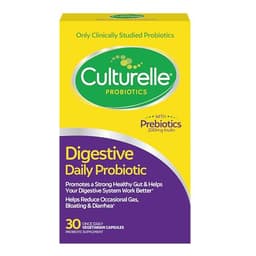
Culturelle Digestive Health (Lactobacillus rhamnosus GG)
Best For
Broadest evidence base of any single strain, especially antibiotic-associated diarrhea prevention
Works In
During antibiotic course, or 4-8 weeks for general use
Price
$17.47
$0.58 / count
Pros
- ✓LGG is among the most-studied probiotic strains in the world, with decades of safety data
- ✓Meta-analysis level evidence supporting reduced antibiotic-associated diarrhea risk
- ✓Widely available, shelf-stable, and inexpensive relative to specialty brands
Cons
- ✗Best evidence is for antibiotic-associated diarrhea, not a cure-all for general digestion
- ✗IBS-specific trial data is thinner than for B. infantis 35624
- ✗Single-strain product won't address issues outside its studied mechanisms
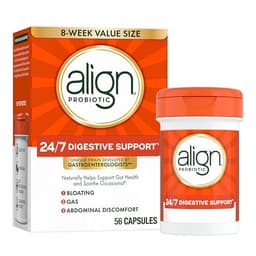
Align Probiotic (Bifidobacterium infantis 35624)
Best For
IBS-type symptoms — bloating, discomfort, irregular bowel habits
Works In
4 weeks
Price
$43.99
$0.79 / count
Pros
- ✓Backed by a 362-patient randomized, dose-ranging trial conducted specifically in IBS patients
- ✓Named among the strains with supportive evidence in a 2026 strain-specific meta-analysis
- ✓Once-daily capsule, no refrigeration required
Cons
- ✗Narrower use case than LGG — built around IBS-type symptoms specifically
- ✗Premium price for a single-strain product
- ✗The proven benefit was tied to a specific studied dose; confirm current labeling matches
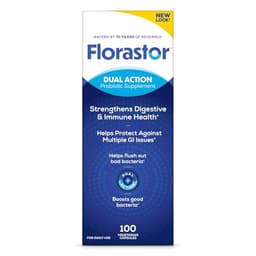
Florastor (Saccharomyces boulardii CNCM I-745)
Best For
Taking alongside antibiotics, or diarrhea-predominant symptoms
Works In
During antibiotic course
Price
$67.99
$0.68 / count
Pros
- ✓A yeast, not a bacterium — can be taken alongside antibiotics without being killed off by them
- ✓Meta-analysis level evidence for reducing antibiotic-associated diarrhea risk
- ✓Long, well-documented safety record in general population use
Cons
- ✗Not appropriate if immunocompromised or if you have a central venous catheter
- ✗IBS-specific evidence for this strain is limited and described as conflicting in recent reviews
- ✗Requires consistent daily dosing to match trial protocols

Seed DS-01 Daily Synbiotic
Best For
People who want a transparent, broad-spectrum synbiotic for general maintenance
Works In
4+ weeks
Price
$59.99
$1.00 / count
Pros
- ✓24-strain formulation paired with a separate prebiotic capsule in a 2-in-1 design
- ✓Publishes third-party viability testing and a transparent full strain list
- ✓Subscription model supports the consistency needed for a proper trial period
Cons
- ✗No published randomized controlled trial specifically on this commercial blend
- ✗Among the most expensive options here at roughly $50/month on subscription
- ✗Large multi-strain blend makes it hard to attribute any change to one component
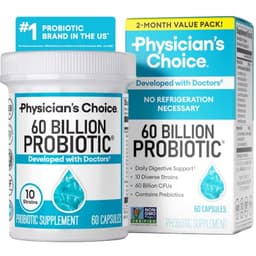
Physician's Choice Probiotic 60 Billion
Best For
High-CFU multi-strain blend with the lowest cost per month of use on this list
Works In
4-8 weeks, if it helps at all
Price
$27.28
$0.45 / count
Pros
- ✓Multi-strain blend of Lactobacillus and Bifidobacterium species, some with independent trial support at the species level
- ✓High labeled CFU count
- ✓Includes organic prebiotic fiber in the formulation
Cons
- ✗No published trial on this specific commercial blend
- ✗A higher CFU count hasn't been shown to outperform the lower, trial-proven doses used in research
- ✗Multi-strain format makes it hard to know what, if anything, is doing the work
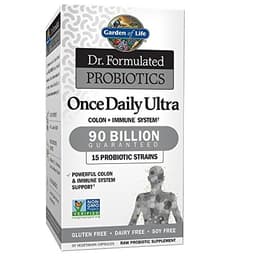
Garden of Life Dr. Formulated Probiotics
Best For
People who prioritize whole-food, non-GMO formulation over strain-specific trial data
Works In
4-8 weeks, if it helps at all
Price
$37.50
$1.25 / count
Pros
- ✓Whole-food and organic-prebiotic formulation may appeal to those avoiding synthetic fillers
- ✓Multi-strain blend covering several well-known probiotic genera
- ✓Third-party tested for potency at several retailers
Cons
- ✗No published randomized trial on this specific commercial blend
- ✗Marketing emphasizes formulation quality more than clinical outcome data
- ✗Overlapping strain claims with less-differentiated evidence than the top picks on this list
Amazon prices retrieved from the Amazon Product Advertising API on . Prices and availability are accurate as of that time and may change.
Several of the blends above also include prebiotic fiber; we rank standalone options separately in our guide to prebiotic fiber supplements.
Who Benefits — and Who Probably Doesn't
You're a reasonable candidate for a targeted probiotic trial if you: are starting a course of antibiotics and want to lower your risk of antibiotic-associated diarrhea; have diagnosed IBS with bloating, discomfort, or irregular bowel habits and want to add a low-risk, evidence-informed option alongside diet and lifestyle changes; or are otherwise healthy and want to try a well-studied strain for a specific, defined symptom.
You're probably not a great candidate — or should temper expectations sharply — if you: are generally healthy with no specific digestive complaint and are hoping for broad "gut health" or immune benefits (the evidence for this use is thin); have already tried two or three well-matched, strain-specific products without any change; or are looking to a probiotic as a substitute for diagnostic workup of persistent or worsening symptoms.
There's also a more surprising nuance worth knowing: in a study of healthy adults recovering from a course of antibiotics, taking a multi-strain probiotic actually delayed the gut microbiome's return to its own pre-antibiotic composition compared with doing nothing, while a personalized fecal transplant restored it faster PMID: 30193113. That's a single mechanistic study, not a reason to avoid probiotics after antibiotics altogether — most clinical trials on AAD prevention still show a net benefit for reducing diarrhea — but it's a useful reminder that "more bacteria" isn't automatically "better gut health," and that the honest answer to "should I take this" is often "it depends on what you're trying to fix."
How to Trial a Probiotic
Pick one product built around a specific, named strain that matches your goal — don't start with a large multi-strain blend if you want to know what's actually helping. Take it consistently, at the labeled dose, for at least 4 weeks; that's roughly the window used in most of the trials cited above. For a defined use like antibiotic-associated diarrhea prevention, start it within a day or two of your first antibiotic dose and continue through the antibiotic course, since that's closer to how the supportive studies were designed PMID: 29257353.
Keep a simple log of the specific symptom you're targeting — stool frequency and consistency, bloating, pain — so you're comparing against your actual baseline. If there's no meaningful change by 8 weeks (or by the end of your antibiotic course, for AAD prevention), it's reasonable to stop rather than continue indefinitely on the assumption that it might eventually help.
Safety and Who Should Be Cautious
Across the trials reviewed above, adverse events with probiotics were generally not more common than with placebo, and the most frequently reported issues were mild and temporary, such as initial gas or bloating as the gut adjusts. That said, probiotics are living organisms, and a specific subset of people face a meaningfully different risk calculation: anyone who is immunocompromised, critically ill, has a central venous catheter, or has had recent gastrointestinal surgery should talk to a physician before starting a probiotic, since rare cases of bloodstream infection traced back to probiotic organisms have been documented in these higher-risk groups PMID: 16762934. Pregnant or breastfeeding individuals, and anyone giving a probiotic to a very young infant, should also check with their care team first rather than choosing a product independently.
Frequently Asked Questions
Do probiotics actually work? Some do, for specific things. Lactobacillus rhamnosus GG and Saccharomyces boulardii have solid evidence for preventing antibiotic-associated diarrhea, and Bifidobacterium infantis 35624 has trial support for IBS symptoms. Most broader "gut health" or immune-support claims aren't backed by comparable strain-specific human trials.
What matters more, the CFU count or the strain? The strain. It's what was actually tested in clinical trials. A high CFU count on a label with no named strain tells you very little about whether that specific product works for anything.
Can probiotics prevent antibiotic-associated diarrhea? Yes — this is one of the better-supported uses in the category, with meta-analysis-level evidence for both Lactobacillus rhamnosus GG and Saccharomyces boulardii CNCM I-745.
Do probiotics prevent C. diff infection? There's moderate-certainty evidence for benefit in people at elevated risk who start a probiotic early alongside antibiotics — not a universal recommendation for everyone taking antibiotics.
Who probably shouldn't take probiotics? People who are immunocompromised, critically ill, have a central venous catheter, or have had recent gut surgery should check with a physician first, due to rare reports of probiotic-related bloodstream infection in these groups.
How long should I trial a probiotic before giving up on it? At least 4 weeks at the labeled dose for general use, or through a full antibiotic course for AAD prevention. Reassess by 8 weeks if you're unsure whether it's helping.
References
- Hill C, Guarner F, Reid G, et al. Expert consensus document: The International Scientific Association for Probiotics and Prebiotics consensus statement on the scope and appropriate use of the term probiotic. Nature Reviews Gastroenterology & Hepatology. 2014;11(8):506-514. PMID: 24912386.
- Hempel S, Newberry SJ, Maher AR, et al. Probiotics for the prevention and treatment of antibiotic-associated diarrhea: a systematic review and meta-analysis. JAMA. 2012;307(18):1959-1969. PMID: 22570464.
- Szajewska H, Kołodziej M. Systematic review with meta-analysis: Lactobacillus rhamnosus GG in the prevention of antibiotic-associated diarrhoea in children and adults. Alimentary Pharmacology & Therapeutics. 2015;42(10):1149-1157. PMID: 26365389.
- Szajewska H, Kołodziej M. Systematic review with meta-analysis: Saccharomyces boulardii in the prevention of antibiotic-associated diarrhoea. Alimentary Pharmacology & Therapeutics. 2015;42(7):793-801. PMID: 26216624.
- Goldenberg JZ, Yap C, Lytvyn L, et al. Probiotics for the prevention of Clostridium difficile-associated diarrhea in adults and children. Cochrane Database of Systematic Reviews. 2017;12(12):CD006095. PMID: 29257353.
- Whorwell PJ, Altringer L, Morel J, et al. Efficacy of an encapsulated probiotic Bifidobacterium infantis 35624 in women with irritable bowel syndrome. American Journal of Gastroenterology. 2006;101(7):1581-1590. PMID: 16863564.
- Maslennikov R, Gosteeva E, Ananeva V, et al. Strain-specific systematic review with meta-analysis of probiotics efficacy in the treatment of irritable bowel syndrome. Journal of Clinical Medicine. 2026;15(3):1152. PMID: 41682832.
- Goodoory VC, Khasawneh M, Black CJ, Quigley EMM, Moayyedi P, Ford AC. Efficacy of probiotics in irritable bowel syndrome: systematic review and meta-analysis. Gastroenterology. 2023;165(5):1206-1218. PMID: 37541528.
- Ford AC, Harris LA, Lacy BE, Quigley EMM, Moayyedi P. Systematic review with meta-analysis: the efficacy of prebiotics, probiotics, synbiotics and antibiotics in irritable bowel syndrome. Alimentary Pharmacology & Therapeutics. 2018;48(10):1044-1060. PMID: 30294792.
- Suez J, Zmora N, Zilberman-Schapira G, et al. Post-antibiotic gut mucosal microbiome reconstitution is impaired by probiotics and improved by autologous FMT. Cell. 2018;174(6):1406-1423. PMID: 30193113.
- Boyle RJ, Robins-Browne RM, Tang MLK. Probiotic use in clinical practice: what are the risks? American Journal of Clinical Nutrition. 2006;83(6):1256-1264. PMID: 16762934.