Metamucil and MiraLAX are the two products most people reach for first, and they are not variations on the same idea — one is a fiber you add to your diet, the other is a laxative that changes how much water stays in your colon. That difference decides which one is likely to work for you, how fast, and what it will do to your gas. This comparison works through the one trial that tested them against each other, what the guidelines say, and the dosing detail that makes fiber look useless when it is not.
This article is for general education and isn't a substitute for care from your own physician or gastroenterologist.
Quick Answer
For chronic constipation, MiraLAX (PEG 3350) has the better evidence: it beat psyllium head-to-head in the one trial that compared them directly, and US gastroenterology guidelines give PEG a strong recommendation while fiber gets only a conditional one. Metamucil (psyllium) is the better pick if you also want its cholesterol and blood-sugar benefits, or prefer a daily fiber habit over a laxative — but it needs more than 10 grams a day for at least four weeks to work, which is roughly three label doses, not one.
Sources: PMID 15991881, PMID 37204227, PMID 35816465
How They Actually Work
MiraLAX is polyethylene glycol 3350, an osmotic laxative. PEG 3350 is a large, inert molecule that your gut does not absorb and your bacteria do not ferment. It stays in the lumen and holds water osmotically, so more water reaches the stool and stays there. Softer stool, easier passage, and a mechanism that does not depend on stimulating the bowel wall or on anything your microbiome does.
Metamucil is psyllium husk, a bulk-forming fiber. The property that makes psyllium work is not that it is "soluble" — it is that it forms a high-viscosity gel and resists fermentation. A detailed review of fiber physics in the gastrointestinal tract made the case that most popular assumptions about soluble versus insoluble fiber are wrong, and that the characteristic actually predicting a laxative benefit is water-holding gel formation that survives the whole length of the colon PMID: 27863994.
That distinction matters more than it sounds, and it is the reason this comparison is not simply "fiber versus laxative." Both products get their effect from the same physical endpoint — more water held in stool. PEG does it directly with an osmotic agent. Psyllium does it with a gel. Everything else that separates them follows from that: speed, dose, side effects, and what else they happen to do to your cholesterol.
The One Head-to-Head Trial
Most product comparisons have to triangulate between separate placebo trials. Here there is a direct one. A randomized, controlled trial in adults with chronic functional constipation assigned 63 patients to PEG 3350 plus electrolytes and 63 to ispaghula husk — ispaghula is psyllium — twice daily for two weeks PMID: 15991881.
The result favored PEG, clearly. Treatment was rated highly effective in 50 of 63 patients on PEG versus 26 of 63 on psyllium, with overall efficacy rates of 92% and 73% (p = 0.005). Mean weekly bowel movements rose from 1.18 at baseline to 8.48 after two weeks on PEG, and from 1.33 to 5.71 on psyllium. Stools were normalized in 87.3% of the PEG group against 66.7% of the psyllium group. Side effects did not differ between the groups, and none were serious.
Three caveats keep this from being the last word, and they all matter:
- It was open-label. Patients and investigators knew which treatment was which, which tends to inflate the apparent benefit of whichever arm feels more like real medicine.
- It ran for two weeks. That is a reasonable window for an osmotic laxative and a short one for fiber, which the meta-analysis evidence below suggests needs about four weeks to show its full effect. The trial's own data show psyllium still climbing between week one and week two.
- The PEG arm was PEG 3350 plus electrolytes — Movicol, the formulation sold in the UK and much of Europe. MiraLAX is PEG 3350 without electrolytes. The active osmotic agent is identical and the added electrolytes exist to limit electrolyte shifts at high doses rather than to boost efficacy, so the result transfers reasonably well. It is not literally a trial of the product in the orange MiraLAX bottle.
- The psyllium arm was arguably under-dosed. Patients took 3.5 g sachets twice daily — 7 grams of psyllium a day. The meta-analysis evidence below finds that fiber's benefit for constipation shows up reliably only above 10 grams a day. So psyllium lost this trial at a dose under the threshold its own evidence base says it needs, over a period shorter than the four weeks that evidence calls for.
Even discounted for all four, this is the only direct evidence that exists, and it points one way. But the last two caveats are the reason we have not written psyllium off: the trial compared a well-dosed laxative against an under-dosed fiber, which is close to how most people actually take them, and arguably that makes it a fair guide to real-world results even where it is not a fair test of psyllium's ceiling.
What the Guidelines Say
The 2023 clinical practice guideline jointly issued by the American Gastroenterological Association and the American College of Gastroenterology reviewed fiber, osmotic laxatives, stimulant laxatives, secretagogues and prucalopride for chronic idiopathic constipation, grading each with the GRADE framework PMID: 37204227.
The panel made strong recommendations for polyethylene glycol, sodium picosulfate, linaclotide, plecanatide and prucalopride. It made conditional recommendations for fiber, lactulose, senna, magnesium oxide and lubiprostone.
That asymmetry is the single most useful fact in this comparison. Two expert bodies reviewing the same literature put PEG 3350 in their top tier and fiber a tier below it. A conditional recommendation is not a rejection — fiber is still recommended — but when the two products you are choosing between sit on opposite sides of that line, the guideline has effectively answered the question for the average person with chronic constipation.
PEG also wins its other head-to-head: a Cochrane review of lactulose versus polyethylene glycol found PEG better across stool frequency, stool form and the need for additional products PMID: 20614462.
Side-by-Side
| MiraLAX | Metamucil | |
|---|---|---|
| Active ingredient | Polyethylene glycol 3350, 17 g per dose | Psyllium husk, ~3.4 g per rounded teaspoon |
| Drug class | Osmotic laxative | Bulk-forming fiber supplement |
| Mechanism | Holds water in the colon osmotically | Forms a non-fermented, water-holding gel |
| Typical onset | 1-3 days | 1-3 weeks, with full effect around 4 weeks |
| Effective dose | One 17 g dose daily | More than 10 g/day — about 3 label doses |
| AGA-ACG 2023 rating | Strong recommendation | Conditional recommendation |
| Head-to-head result | 92% overall efficacy | 73% overall efficacy |
| Gas and bloating | Minimal — not fermented | Common early on; improves with slow titration |
| Beyond constipation | None | Lowers LDL cholesterol; improves glycemic control |
| Taken as | Powder stirred into any drink, tasteless | Flavored powder, capsules, or wafers |
| Typical cost | ~$20/mo | ~$20/mo at one dose; ~$30/mo at an effective dose |
| Where to buy |
Our Rankings
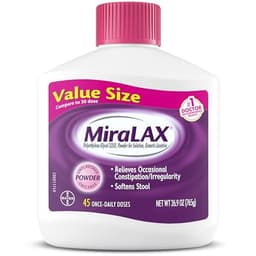
MiraLAX (Polyethylene Glycol 3350)
Best For
Most adults with chronic constipation, and anyone who wants results this week
Works In
1-3 days
Price
$31.47
$1.17 / ounce
Pros
- ✓Strong recommendation for chronic idiopathic constipation in the 2023 joint AGA-ACG guideline — the top evidence tier, which fiber did not reach
- ✓Beat psyllium in the only randomized head-to-head trial: 92% vs 73% overall efficacy, and 8.48 vs 5.71 weekly bowel movements after two weeks
- ✓Works in 1-3 days rather than weeks, so you find out quickly whether it helps you
- ✓Not fermented by gut bacteria, so it causes very little gas or bloating — the main reason people abandon fiber
- ✓Not absorbed systemically and not habit-forming in the way stimulant laxatives can be
- ✓Tasteless and dissolves in any drink, which makes daily adherence easy
Cons
- ✗Treats constipation and nothing else — no cholesterol, glycemic or satiety benefit
- ✗The head-to-head trial used PEG 3350 plus electrolytes (Movicol), not the electrolyte-free formulation sold as MiraLAX
- ✗Overshooting the dose causes loose stools; it is easier to overdo than fiber
- ✗In IBS-C it improves bowel movements but did not beat placebo for abdominal pain, so it treats half the problem
- ✗Needing it daily and indefinitely is a reason to get the constipation investigated, not a long-term plan
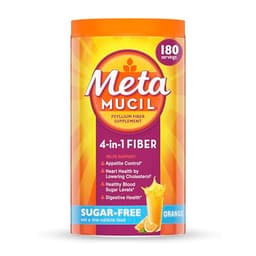
Metamucil (Psyllium Husk Fiber)
Best For
People who want one product to improve regularity, cholesterol and blood sugar together
Works In
1-3 weeks of consistent use
Price
$34.97
$0.95 / ounce
Pros
- ✓The best-evidenced fiber for constipation: in a meta-analysis of 16 RCTs and 1,251 participants, 66% responded to fiber versus 41% on control, and psyllium was one of only two fiber types with a significant effect
- ✓Non-fermented and gel-forming, the two physical properties that actually predict a laxative effect
- ✓Also lowers LDL cholesterol and improves glycemic control — a genuine second and third benefit no laxative offers
- ✓Helped overall symptom severity in IBS in a primary-care randomized trial, where insoluble bran did not
- ✓Adds soft bulk rather than drawing water osmotically, which some people find produces a more normal-feeling stool
- ✓Available as flavored powder, capsules or wafers, so there is a format most people can stick with
Cons
- ✗Only a conditional recommendation in the 2023 AGA-ACG guideline, a tier below PEG 3350
- ✗Lost the head-to-head trial against PEG on every efficacy measure reported
- ✗Needs more than 10 g/day for at least four weeks to work reliably — roughly three label doses, which is far more than most people take
- ✗Flatulence was significantly higher than control in the meta-analysis, and it is the most common reason people quit
- ✗Must be taken with a full glass of water, and swallowing it dry or with too little fluid risks choking or obstruction
- ✗Slow and less predictable: a bad week tells you nothing, which makes it harder to judge
Amazon prices retrieved from the Amazon Product Advertising API on . Prices and availability are accurate as of that time and may change.
Which One Fits Your Situation
The guideline answer is MiraLAX, but the guideline is written for the average patient and you are not one. These are the situations where the choice flips.
You want results this week. MiraLAX. One to three days versus one to three weeks is not a close call, and psyllium's slow, variable onset makes it genuinely hard to tell whether it is working.
You also have high LDL cholesterol or are managing blood sugar. Metamucil. Psyllium has meta-analysis support for lowering LDL cholesterol, and a randomized trial in patients with type 2 diabetes and chronic constipation found it improved constipation, glycemia and lipids against placebo PMID: 30219432. Getting three benefits from one $20 canister is a real argument, and PEG offers nothing beyond the bowel.
Gas and bloating are already your main complaint. MiraLAX. PEG is not fermented, so it adds essentially no gas. Psyllium raised flatulence significantly versus control in the meta-analysis PMID: 35816465, and adding gas to a gas problem is a poor trade even if your stools improve.
You have IBS with constipation. Both, with managed expectations. PEG 3350 plus electrolytes beat placebo for bowel movements in a 139-patient IBS-C trial, but produced no improvement in abdominal pain compared with placebo PMID: 23835436. Psyllium is the better bet for the pain side: in a primary-care randomized trial of 275 IBS patients, soluble psyllium improved overall symptom severity while insoluble bran did not PMID: 19713235. Our IBS-C vs IBS-D guide covers how the subtypes diverge.
Your stool is hard and dry rather than infrequent. MiraLAX, and probably at a lower dose than the label suggests. Pulling water in directly is the shortest path to a softer stool.
You would rather build a habit than take a drug. Metamucil, honestly assessed. A daily fiber dose you will still be taking in a year beats an osmotic laxative you resent. Just take the real dose — see below.
The Dosing Mistake That Makes Fiber Look Useless
This is the most common reason people conclude Metamucil does not work for them, and it is a dosing problem rather than a product problem.
An updated systematic review and meta-analysis of fiber supplementation in chronic constipation pooled 16 randomized controlled trials covering 1,251 participants PMID: 35816465. Fiber worked: 311 of 473 participants (66%) responded versus 134 of 329 (41%) on control, a risk ratio of 1.48. But the detail is in the subgroup analysis. A higher response was apparent only with doses above 10 grams per day, and the improvement in stool frequency appeared only with higher doses and treatment lasting at least four weeks. Of the fiber types reviewed, only psyllium and pectin had significant effects.
Now do the arithmetic on the canister. A rounded teaspoon of Metamucil powder is about 3.4 grams of psyllium husk. To clear 10 grams a day you need roughly three doses, every day, for a month. The label permits that — up to three times daily is standard dosing — but most people take one teaspoon in the morning, give it a week, and decide fiber is a myth. They never reached a dose the evidence supports, for a duration the evidence supports.
Two practical consequences. First, budget for it: an effective dose is three times the cheapest-looking dose, which is why the comparison table lists Metamucil at both a nominal and an effective monthly cost. Second, titrate up slowly over two to three weeks rather than starting at three doses, because the gas and bloating that make people quit are worst when the dose jumps suddenly. And take each dose with a full glass of water — psyllium that does not get enough fluid is a choking and obstruction risk, not merely less effective.
Metamucil vs Plain Psyllium Husk: Is the Brand Worth It?
Metamucil's active ingredient is psyllium husk, and plain psyllium husk powder is sold for considerably less per gram. On the evidence, there is no meaningful difference: the trials behind psyllium's reputation used psyllium, and the clinical literature includes several brands — the head-to-head trial above used Konsyl, not Metamucil.
So the honest answer is that you are paying for flavoring, format and palatability. Whether that is worth it depends entirely on the dosing problem above. An effective regimen is three doses a day for at least four weeks, and the limiting factor for almost everyone is not cost but whether they can stand to drink the stuff that long. If a flavored powder or a capsule is what gets you to week four at 10 grams a day, it has earned its premium. If you will happily stir unflavored husk into water indefinitely, buy the cheap bag and put the difference toward something else.
Two unflavored options worth knowing about, for different reasons:
Konsyl is the psyllium brand actually used in the head-to-head trial above — when that study reported 73% efficacy for "ispaghula husk," Konsyl is what the patients took. Its current unflavored Daily powder is sold in a 19-ounce tub listing 90 servings, which works out to roughly 6 grams of psyllium per serving: close to double Metamucil's roughly 3.4 grams per rounded teaspoon, so you clear the 10-gram threshold in two servings rather than three.
NOW Organic Psyllium Husk Powder is the cheap-per-gram benchmark — plain certified-organic husk with nothing added, no sweetener and no flavoring, at roughly half the price of a branded flavored canister. It is the option to choose if what you want is psyllium and only psyllium.
Two caveats on format. Metamucil capsules contain considerably less psyllium per unit than a teaspoon of powder, so reaching an effective dose takes a lot of them — check grams per serving rather than assuming a capsule equals a dose. And whole husk behaves differently from fine powder in water: it is coarser and needs more vigorous stirring and more fluid, which some people find harder to get down than a flavored powder, not easier.
What About Benefiber and Citrucel?
Both come up in the same aisle, and they are not equivalent substitutes.
Benefiber is wheat dextrin, and the mechanism argues against it for constipation. Wheat dextrin is soluble but non-viscous — it does not form a gel — and it is readily fermented by gut bacteria. A clinical review of well-controlled trials concluded that to produce a laxative effect a fiber must resist fermentation and significantly increase stool water content, and that readily fermented fibers, whether gel-forming or not, have no effect on stool output and no laxative effect PMID: 27680987. Wheat dextrin is named in that review as a non-viscous soluble fiber. If your goal is regularity, this is the weakest of the options on this page.
Worth disclosing: the lead author of that review was employed by Procter & Gamble, which owns Metamucil. The mechanistic argument is consistent with the broader fiber-physics literature and with the meta-analysis finding that only psyllium and pectin had significant effects, but a reader should know the conflict exists and weigh it.
Citrucel is methylcellulose, and it belongs in a different bucket from Benefiber. Methylcellulose is non-fermented and does form a gel, which puts it mechanistically alongside psyllium rather than against it. Its clinical evidence is simply much thinner and much older. The main trial, published in 1988, gave 59 chronically constipated patients 1, 2 or 4 grams of methylcellulose daily or 3.4 grams of psyllium, and found that all doses significantly increased stool frequency, water content and fecal solids — methylcellulose was effective at a dose as low as 1 gram PMID: 2839321. That is a genuine positive result, and it is nearly four decades old with little modern follow-up.
So: Citrucel is a defensible alternative if psyllium gives you too much gas, since a lower gram dose does the job and methylcellulose is not fermented either. Psyllium remains the better-evidenced default, with repeated modern trials and meta-analysis support behind it. One label detail to check before you buy: the standard orange Citrucel powder is sweetened with sucrose, and the sugar-free version is a separate product that is most often sold as a multipack.
For the wider fiber field, including partially hydrolyzed guar gum and the IBS-specific options, see our ranked guide to fiber supplements.
Can You Take Both?
Yes, and it is a common clinical combination. The mechanisms are independent — psyllium adds a water-holding gel to the stool, PEG pulls water into the colon — so there is no pharmacological conflict and no reason to expect the pair to be less effective than either alone.
The practical advice is to add them one at a time, a week or two apart. If you start both together and your bowels improve, you have learned nothing about which one to keep paying for; if you get bloated, you do not know which to drop. Introduce one, give it its proper window — days for PEG, weeks for psyllium — then add the second if the first was not enough.
A reasonable combined pattern for stubborn chronic constipation is daily psyllium as the baseline habit, with PEG added when the baseline is not holding. Our constipation relief guide covers where stimulant laxatives like Senokot and Dulcolax fit alongside both, and why they are a short-term tool rather than a daily one.
Safety and Who Should Be Cautious
Neither product is high-risk for most adults, but they fail in different directions.
Psyllium must be taken with plenty of fluid. Taken dry or with too little water it can swell in the esophagus or gut, and the real risks are choking and bowel obstruction. Anyone with a known stricture, a history of bowel obstruction, difficulty swallowing, or significantly slowed gut motility should clear bulk-forming fiber with a doctor first. Psyllium can also interfere with the absorption of some medications, so separate doses from your prescriptions by at least two hours. Expect more gas in the first couple of weeks; that is the fermentation of the small fraction that does get fermented plus the general adjustment, and it usually settles.
PEG 3350 is not absorbed and is generally very well tolerated — adverse events in the head-to-head trial did not differ from psyllium, and none were serious PMID: 15991881. The common problems are dose-related: overshoot and you get loose stools, cramping or urgency. In the IBS-C trial, drug-related abdominal pain occurred in 4.5% on PEG versus 0% on placebo, and diarrhea in 4.5% versus 4.3% PMID: 23835436. People with significant kidney disease, or anyone taking large daily doses long term, should be supervised because of electrolyte considerations.
Neither should be started by someone who has not had new, persistent constipation looked at, which brings us to the part that matters more than either product.
When to See a Doctor Instead
Self-treating is reasonable for familiar, uncomplicated constipation. It is not reasonable for any of the following, which warrant a medical assessment rather than a trip to the laxative aisle:
- Blood in your stool, or black, tarry stools
- Unexplained weight loss
- A persistent change in your bowel habits after age 45
- Constipation alternating with diarrhea that is new for you
- Severe abdominal pain, vomiting, or no bowel movement combined with an inability to pass gas
- Constipation that started with a new medication, or shortly after an illness
- A family history of colorectal cancer or inflammatory bowel disease
- Constipation needing daily treatment for months on end
Chronic constipation also has treatable underlying causes — thyroid disease, pelvic floor dysfunction, medication side effects — that no amount of fiber or PEG will address, and some of them are diagnosed easily once someone looks.
Honest Verdict
If you want one answer: MiraLAX. It won the only head-to-head trial, it sits in the guidelines' top tier while fiber sits a tier below, it works in days instead of weeks, and it does not add gas to a gut that is already unhappy. For the average adult with chronic constipation who wants the problem to stop, that is the straightforward pick.
Metamucil is the better product for a narrower, real set of people: those who also want psyllium's cholesterol and glycemic benefits, those who prefer a dietary habit to a laxative, and those whose main problem is stool that is too soft and formless rather than too hard. It is a genuinely good fiber — the best-evidenced one — and the gap between it and PEG in the head-to-head trial was a gap between 73% and 92%, not between useless and useful. If you choose it, the thing that decides your outcome is not the brand but the dose: more than 10 grams a day, titrated up slowly, for at least four weeks.
Both are cheap, both are available everywhere, and they combine safely, so the cost of guessing wrong is a few weeks and about twenty dollars.
| MiraLAX — our pick | Metamucil — the fiber case | |
|---|---|---|
| Choose it if | You want the best-evidenced option and results within days | You want regularity plus cholesterol and glucose benefits, and will take a real dose for a month |
| Where to buy |
Frequently Asked Questions
Is MiraLAX or Metamucil better for constipation? MiraLAX has the stronger evidence. In the only randomized trial comparing them directly, PEG 3350 plus electrolytes reached 92% overall efficacy versus 73% for psyllium, with more weekly bowel movements. The 2023 AGA-ACG guideline gives PEG a strong recommendation and fiber only a conditional one. Metamucil remains a reasonable choice, especially if you want fiber's cholesterol and glucose benefits too.
Can you take Metamucil and MiraLAX together? Yes. They work by different mechanisms, so there is no pharmacological conflict and clinicians commonly combine them. Add one at a time, a week or two apart, so you can tell which is doing what.
How long does each one take to work? MiraLAX usually works within 1 to 3 days. Psyllium is slower and less predictable: the meta-analysis evidence points to doses above 10 grams a day for at least four weeks before you can judge it fairly.
Is Benefiber as good as Metamucil for constipation? No. Benefiber is wheat dextrin — readily fermented and non-gelling — and a review of well-controlled trials found that fermented fibers have no laxative effect. Psyllium resists fermentation and holds its gel through the colon, which is why it works where wheat dextrin does not.
Citrucel vs Metamucil: which is better? Citrucel is methylcellulose, which is non-fermented and gel-forming, so it is mechanistically much closer to psyllium than to Benefiber. Its evidence is thinner and far older — the key trial is from 1988 — while psyllium has repeated modern trials and meta-analysis support. Citrucel is a fair alternative if psyllium causes too much gas; psyllium is the better-evidenced default.
Is generic psyllium husk the same as Metamucil? The active ingredient is identical, and the head-to-head trial above actually used Konsyl rather than Metamucil. You are paying Metamucil for flavoring and format. That is worth it only if palatability is what gets you to four weeks at an effective dose — which, for most people, it is. Plain unflavored husk costs roughly half as much per gram, and Konsyl's unflavored Daily powder works out to about 6 grams per serving against Metamucil's 3.4 per teaspoon, so it also takes fewer daily servings to reach an effective amount.
Is it safe to take MiraLAX every day long term? PEG 3350 is not absorbed systemically, is not habit-forming the way stimulant laxatives can be, and has been used daily in trials without serious adverse effects. But constipation that needs daily treatment indefinitely should be investigated rather than managed forever on your own.
Which one is cheaper? At face value they are similar, around $20 a month. At an effective psyllium dose of three servings daily, Metamucil costs more per month than MiraLAX — the opposite of what the shelf price suggests.
References
- Wang HJ, Liang XM, Yu ZL, Zhou LY, Lin SR, Geraint M. A randomised, controlled comparison of low-dose polyethylene glycol 3350 plus electrolytes with ispaghula husk in the treatment of adults with chronic functional constipation. Drugs in R&D. 2005;6(4):221-225. PMID: 15991881.
- Chang L, Chey WD, Imdad A, et al. American Gastroenterological Association-American College of Gastroenterology Clinical Practice Guideline: Pharmacological Management of Chronic Idiopathic Constipation. The American Journal of Gastroenterology. 2023;118(6):936-954. PMID: 37204227.
- van der Schoot A, Drysdale C, Whelan K, Dimidi E. The Effect of Fiber Supplementation on Chronic Constipation in Adults: An Updated Systematic Review and Meta-Analysis of Randomized Controlled Trials. The American Journal of Clinical Nutrition. 2022;116(4):953-969. PMID: 35816465.
- McRorie JW, Chey WD. Fermented Fiber Supplements Are No Better Than Placebo for a Laxative Effect. Digestive Diseases and Sciences. 2016;61(11):3140-3146. PMID: 27680987.
- McRorie JW Jr, McKeown NM. Understanding the Physics of Functional Fibers in the Gastrointestinal Tract: An Evidence-Based Approach to Resolving Enduring Misconceptions about Insoluble and Soluble Fiber. Journal of the Academy of Nutrition and Dietetics. 2017;117(2):251-264. PMID: 27863994.
- Lee-Robichaud H, Thomas K, Morgan J, Nelson RL. Lactulose versus Polyethylene Glycol for Chronic Constipation. Cochrane Database of Systematic Reviews. 2010;2010(7):CD007570. PMID: 20614462.
- Chapman RW, Stanghellini V, Geraint M, Halphen M. Randomized clinical trial: macrogol/PEG 3350 plus electrolytes for treatment of patients with constipation associated with irritable bowel syndrome. The American Journal of Gastroenterology. 2013;108(9):1508-1515. PMID: 23835436.
- Bijkerk CJ, de Wit NJ, Muris JW, Whorwell PJ, Knottnerus JA, Hoes AW. Soluble or insoluble fibre in irritable bowel syndrome in primary care? Randomised placebo controlled trial. BMJ. 2009;339:b3154. PMID: 19713235.
- Hamilton JW, Wagner J, Burdick BB, Bass P. Clinical evaluation of methylcellulose as a bulk laxative. Digestive Diseases and Sciences. 1988;33(8):993-998. PMID: 2839321.
- Noureddin S, Mohsen J, Payman A. Effects of psyllium vs. placebo on constipation, weight, glycemia, and lipids: A randomized trial in patients with type 2 diabetes and chronic constipation. Complementary Therapies in Medicine. 2018;40:1-7. PMID: 30219432.
- Chey SW, Chey WD, Jackson K, Eswaran S. Exploratory Comparative Effectiveness Trial of Green Kiwifruit, Psyllium, or Prunes in US Patients With Chronic Constipation. The American Journal of Gastroenterology. 2021;116(6):1304-1312. PMID: 34074830.